
Mentoring in Practice
Mentoring can be a powerful way to retain staff, develop a talent pipeline, and support professional development.
The Mentoring Hub provides practical resources to support mentoring programs. Each tool has been intentionally created to enhance the experience and outcomes.
Why Mentoring Matters
Mentees benefit through its meaningful professional development and personalized support. As the mentoring relationship develops, trust and transparency grow, allowing for deeper conversations, guidance, and insights. When mentoring takes place within an organization, it helps build a pipeline for career growth and development.
Mentors benefit by strengthening their leadership and mentoring skills, while also supporting their organization. Through a mentoring program, mentors contribute to increasing engagement, developing talent pipelines, and fostering skill growth.
Praeliscere’s Mentoring Hub

Below, you’ll find a detailed breakdown of the Mentoring Hub. Select the title to go directly to the resource.

The Mentorship Program

The Mentorship Program is designed to guide through key developmental areas. Individuals are encouraged to bring additional topics to discuss during their twice-monthly meetings. The six-month duration is intended to support meaningful progress toward the mentees goals and address key challenges. While also allowing time to build a strong mentor mentee relationship and foster open, productive dialogue.
Mentee Intake Form

The Mentee Intake Form is designed to gain insight into key factors that support a strong partnership between a Mentor and Mentee. When the best partnership is selected, these insights are used to shape an experience that is intentionally tailored to support the mentee.
The Form dives into:
- Personalized Preferences
- Professional Background and Aspirations
- Motivation for Seeking a Mentor and Insights
Mentor Application Form

The Mentor Application Form is designed to gain insight into key factors that support a strong partnership between a Mentor and Mentee. When the best partnership is selected, this form then becomes a guide for insights into making the experience tailored to each individual.
The Form dives into:
- Personalized Preferences
- Professional Background and Aspirations
- Motivation for Seeking to Become a Mentor
- Mentorship Approach and Style
- Skills and Strengths
Mentor Training

Conducting a Mentor Training before the mentoring program officially begins between a mentor and mentee can reiterate expectations, benefits of the program, and overview. Foundational training agenda includes:
- Icebreaker
- What is a Mentor?
- Benefits of Mentorship
- Mentoring Skills
- Program Overview & Expectations
- Mentee Intake Form

Mentee Self Evaluation
Form

Completing the self evaluation form can support additional personal growth and tailor adjustments for the remainder of the mentor program or for future mentor programs. Insights from the self evaluations can be shared but is completely optional.
Mentor Self Evaluation
Form

Completing the self evaluation form can support additional personal growth and tailor adjustments for the remainder of the mentor program or for future mentor programs. Insights from the self evaluations can be shared but is completely optional.
Post Mentoring Program
Feedback

When a full mentoring program is completed, a post mentoring program feedback form is used to better understand where impact occurred and where improvements can be made. This feedback is then turned into actionable steps to refine and strengthen future mentoring programs. Anonymous responses are encouraged, as they support more honest and transparent feedback.
Mentee and Mentor Post Program Check In
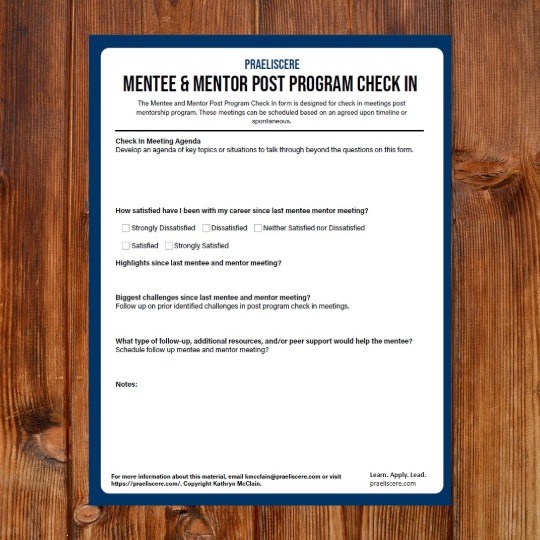
Mentees and Mentors may want to maintain their relationship and continue to have check ins post program. This form will help guide the conversations and agenda for these meetings.
Facilitator Notes
- Personalization: As the facilitator, you are encouraged to adjust the exercise to meet the needs of all team members.
- Pre-Communication: Share agenda or exercise document at least 48 hours prior to exercise/training. This will allow time for individuals to review and ask clarifying questions prior to the meeting. Make sure to include session length of time and expectations in prior communication (e.g., if virtual, cameras/microphones expectations).
- Directed Examples: Provide relevant examples when going through sections.
- Psychological Safety: No calling on individual participants to put them on the spot.
Keep in mind when delivering your exercise/training those that are neurodivergent, non-native English speakers/ESL, introverts, internal processors, and those that may be burned out/cognitive overload.

Discover Your Next Resource
While each resource has a primary home hub, human skills are interconnected and can be utilized across multiple areas. Dive further into our hubs for resource exploration.
Ongoing Application and Reinforcement
After a training, exercise, or assessment is completed, ongoing application and reinforcement become the focus. Learning is sustained through follow-up trainings, exercises, and/or micro-learning opportunities, as well as by integrating the topic into goals, performance conversations, recognition efforts, and peer learning groups.
As individuals build knowledge, experience, and confidence, they are empowered to lead, share insights, and support others in applying the learning as well. This approach reflects the meaning of Praeliscere with Learn, Apply, Lead.
What should we build next?
Our resources are shaped by the people who use them. Use our quick feedback form to suggest new topics, tell us what we are doing well or how we can improve our current resources. Click here for our Resource Feedback Form
Learn. Apply. Lead.
Practical Insights Delivered. Get access to new tools and workplace-ready resources as they’re released monthly.
Stay in the loop with our latest insights, resources, and updates by connecting with us on LinkedIn and Facebook. It’s a great way to engage with our work and join the conversation.