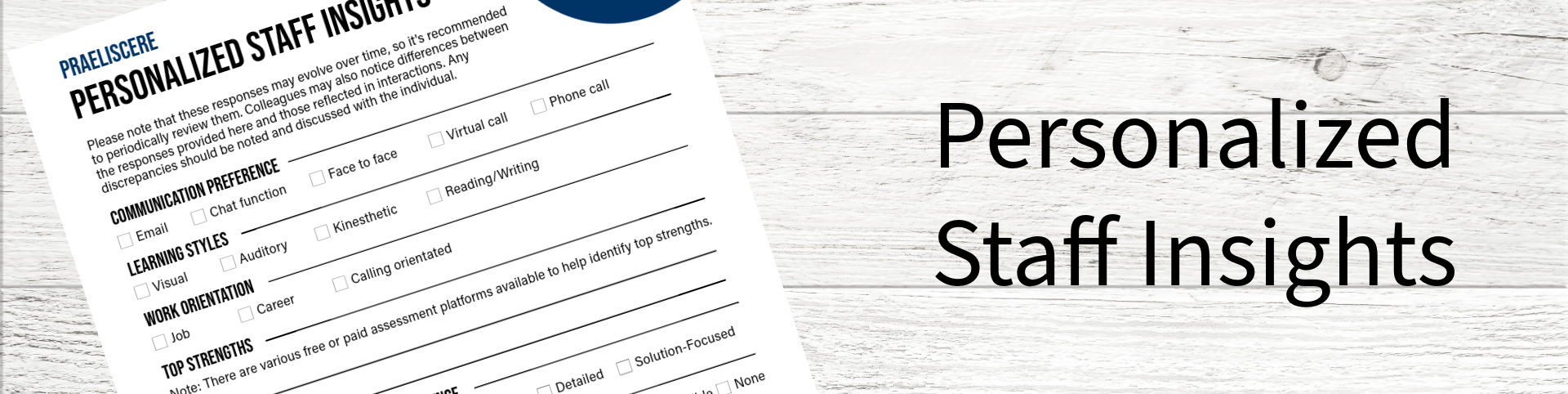
Unlock the power of personalized employee engagement with our affordable, easy-to-use one-sheeter.
Designed to gather essential staff insights, including communication preferences, learning styles, work orientation, top strengths, coaching communication styles, recognition preferences, forms of appreciation, and celebration preferences—this tool supports more meaningful connections and better workplace outcomes.
Perfect for onboarding or first-time use with current staff, this resource helps managers, HR professionals, and team leads gain a deeper understanding of their team members.
Why These Personalized Insights Matters
By using these insights, you can foster stronger relationships, boost employee engagement, and drive performance and retention with a more personalized approach to management and support.
Helpful Tip for Applying Insights
Looking up or having to remember an individual’s preferences can be hard or time-consuming. There are multiple ways to help ease this on your team or companywide. One way you can alleviate this is by documenting preferences in the “Notes” section of your contact card profile. Once added, clicking a person’s name or hovering over will share their contact card with these preferences.
If your email system does not support contact card profiles, other options are to utilize contact notes or include preferences in the email signature.
Below, you’ll find a detailed breakdown of the Personalized Staff Insights Hub, including:
- Personalized Staff Insights document (A High Impact, Low Cost Product)
- Reviewing Insights
- Communication Preference
- Learning Styles
- Work Orientation
- Top Strengths
- Coaching Communication Style Preference
- Recognition Preferences
- Forms of Appreciation
- Celebration Preferences
Personalized Staff Insights Resource Breakdown
You’ll find a detailed breakdown of each question included in the one-sheeter, along with response options and what they can reveal about a team member’s preferences and working style.
Periodically Review Insights
The insights gathered from the Personalized Staff Insights printable may evolve over time, so we recommend reviewing them periodically. Colleagues might also notice differences between the responses provided and those observed in daily interactions. Any discrepancies should be addressed through open discussion with the individual. It’s possible that the team member may not be fully aware of a learning style or recognition preference they respond to more effectively or may not realize how they’re engaging with different coaching or recognition methods.
Communication Preference
Every individual has their own preferred communication style. Explore these preferences by learning what works best in different contexts, such as one-on-one meetings, team discussions, daily check-ins, or coaching conversations.
Email • Chat Function • Face to Face • Virtual Call • Phone Call
Learning Styles
Everyone has their preferred learning style. Gaining knowledge and understanding with these preferences can provide valuable insights for tailoring training sessions. Whether it’s during onboarding, annual compliance training, or ongoing professional development throughout the year, knowing how each individual learns best can enhance the effectiveness of these sessions.
- Visual Learner – Visual formats (e.g. images or charts)
- Auditory Learner – Listening and speaking (e.g. audio recordings or lectures)
- Kinesthetic Learner – Hands on activities (e.g. role play or games/exercises)
- Reading/Writing Learner – Reading and writing (e.g. notes or essays)
Work Orientation
The perspective of work can vary greatly and may evolve over time. These differing views influence how people approach tasks, prioritize responsibilities, and engage with their work.
- Job – The focus is primarily on work-life balance and providing for oneself and/or their family.
- Career – The focus is on continual professional growth.
- Calling – The focus is on finding purpose in life through work, often driven by a desire to help others rather than personal gain.
Top Strengths
There are various free or paid assessment platforms available to help identify top strengths. Recognizing and discussing these strengths can provide valuable insights into how to leverage them for personal growth, team dynamics, and overall performance.
Gain deeper insight into individual strengths with our complimentary instant downloadable Strengths Assessment Reflection. This free resource offers thoughtful reflection questions to help individuals and teams better understand, apply, and build on their unique strengths.
Coaching Communication Style Preference
What one employee may perceive as the most effective form(s) to communicate coaching; another may view as unmotivating and/or damaging to the relationship with their leader. Depending on the situation and the seriousness of the coaching, greater emphasis may be placed on certain coaching styles, even if they aren’t the individual’s primary preference.
- Direct – Communication to be straightforward and clear
- Supportive – Communication to be empathic, compassionate, constructive feedback, and active listening
- Gentle – Communication to be warm and calm
- Collaborative – Communication to be shared decision-making, more of a partnership
- Detailed – Communication that is specific feedback and next steps
- Solution-Focused – Communication to be on what goals to achieve
Recognition Preference
Recognition should be given when an individual’s performance reaches a level that deserves acknowledgment. The type of recognition can vary, with preferences differing between formal and informal forms of acknowledgment.
- Public Praise and/or Private Praise
- Verbal and/or Written
- Tangible and/or Intangible
- None
Employees may have preferences regarding who delivers recognition, whether it’s their direct managers, senior leadership, direct reports, peers, or customers/clients. The preference for who delivers recognition can also depend on whether it is more formal or informal.
Head to the Appreciation & Recognition section of the site for a deeper breakdown of recognition preferences, appreciation styles, and practical ways to tailor your approach for each individual.
Forms of Appreciation
Appreciation should be consistent and practiced regularly. To make it most effective, it’s important to understand which form(s) of appreciation will have the greatest impact.
- Acts of Service – An action that will benefit the employee (e.g. handling their shift/part of shift, running work errands)
- Words of Affirmation – Specific verbal expressions (e.g. be specific with their skills/strengths showing appreciation for)
- Tangible Gifts – Material objects (e.g. work swag items, plaque, gift cards)
- Quality Time – Sincere direct interaction with leadership (e.g. lunch with leader(s), one on one meeting)
- Proof of Impact – Emphasize the impact an employee’s work has had in the community, overall work mission, or within their role at the organization. (e.g. data or metrics, customer/client testimonials)
Head to the Appreciation & Recognition section of the site for a deeper breakdown of recognition preferences, appreciation styles, and practical ways to tailor your approach for each individual.
Celebration Preference
Assumptions shouldn’t be made about celebrations with birthdays and work anniversaries. Not all employees prefer to have their work anniversaries or birthdays celebrated for various reasons.
This section not only highlights preferred snacks, treats, or items to avoid for work anniversary and birthday celebrations, but also offers ideas for showing appreciation and recognition to colleagues in meaningful ways.
High Impact, Low Cost Products
Affordable, Instant Download: Personalized Staff Insights One-Sheeter
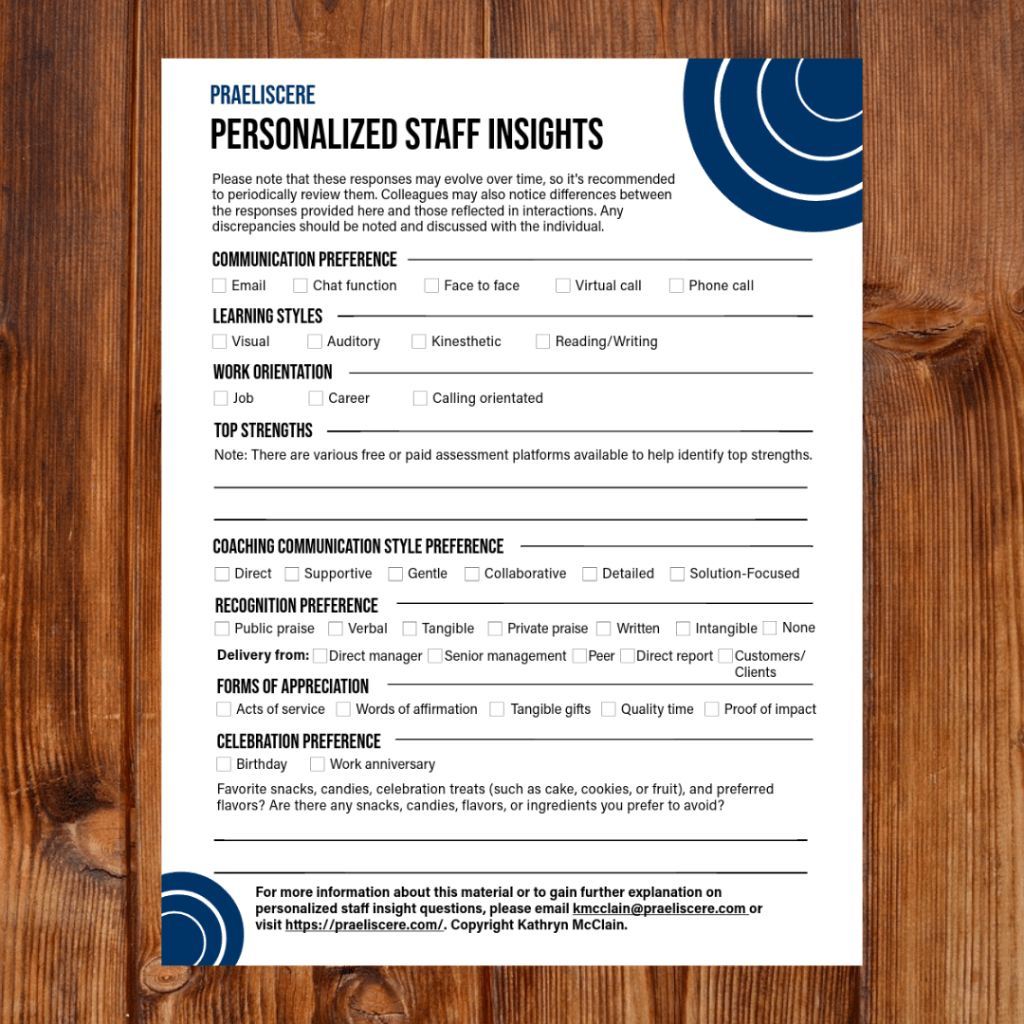
Unlock deeper understanding of your team with this affordable, easy-to-use Personalized Staff Insights one-sheeter. This comprehensive resource captures key information on each employee’s unique strengths, work orientation, learning styles, and preferences for communication, coaching, recognition, appreciation, and celebration.
Use these insights to build a more engaged, collaborative, and high-performing team. By tailoring your approach to each individual’s needs, you’ll foster stronger connections, boost employee satisfaction, and create a workplace culture that empowers every team member to thrive.
Learn. Apply. Lead.
Practical Insights Delivered. Get access to new tools, reflections, and workplace-ready resources as they’re released monthly.
Stay in the loop with our latest insights, resources, and updates by connecting with us on LinkedIn and Facebook. It’s a great way to engage with our work and join the conversation.
 Praeliscere