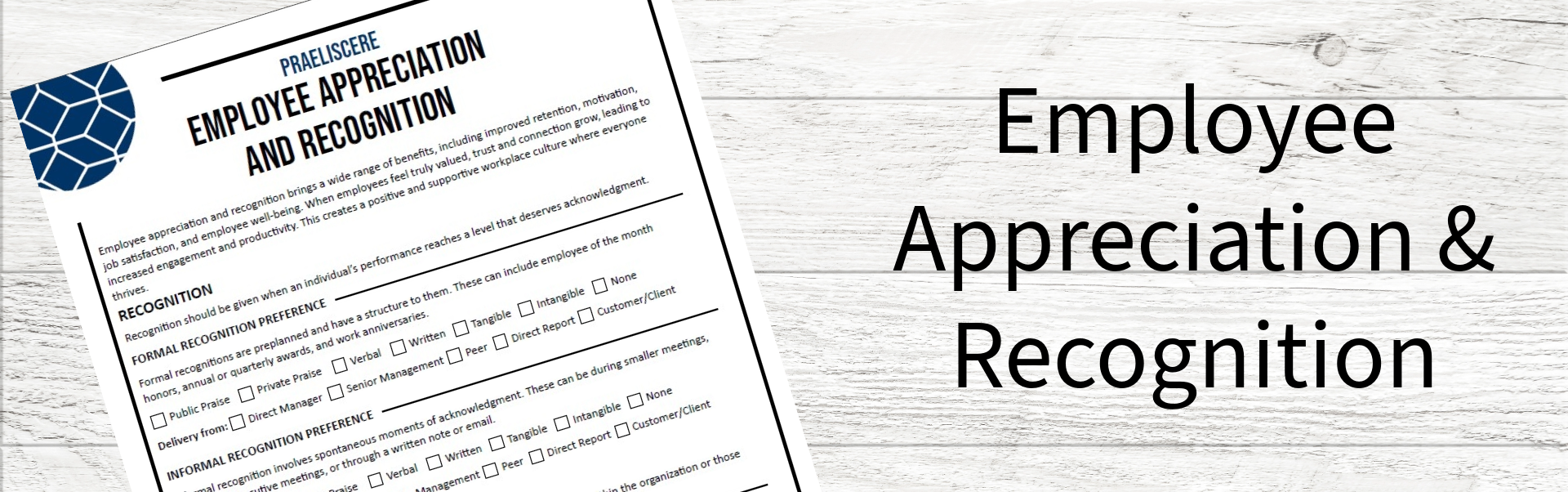
Employee appreciation and recognition are major factors of a thriving workplace.
These insights are valuable for HR professionals, team leaders, and anyone invested in employee engagement and retention. Use them to build a culture where people feel respected, motivated, and proud to contribute.
Why Appreciation & Recognition Matters
When employees feel genuinely valued and acknowledged for their contributions, it leads to increased employee engagement, higher retention rates, improved job satisfaction, and enhanced workplace well-being.
Whether through formal recognition programs or simple day-to-day expressions of gratitude, effective recognition builds trust, strengthens team morale, and fosters a more inclusive, positive workplace culture. Personalized appreciation efforts support stronger manager-employee relationships, encourage high performance, and contribute to a culture of motivation and collaboration.
Helpful Tip for Applying Insights
Looking up or having to remember an individual’s preferences can be hard or time-consuming. There are multiple ways to help ease this on your team or companywide. One way you can alleviate this is by documenting preferences in the “Notes” section of your contact card profile. Once added, clicking a person’s name or hovering over will share their contact card with these preferences.
If your email system does not support contact card profiles, other options are to utilize contact notes or include preferences in the email signature.
Below, you’ll find a detailed breakdown of the Employee Appreciation & Recognition Hub, including:
- Employee Appreciation and Recognition document
- Employee Appreciation Preferences
- Employee Recognition Preferences (Formal and Informal)
- Preferences of Delivery for Recognition (Formal and Informal)
- Recognition Ideas (Formal and Informal)
- Milestone achievement reward selection document (A High Impact, Low Cost Product)
- Choosing Milestones
- Choosing Milestone Reward Options
Recognition and Appreciation
Employee Appreciation Preferences
Appreciation should be consistent and regularly practiced, coming from anyone within the organization or those connected to it, including teammates, direct reports, and leadership.
FORMS OF APPRECIATION:
- Acts of Service – An action that will benefit the employee (e.g. handling their shift/part of shift, running work errands)
- Words of Affirmation – Specific verbal expressions (e.g. be specific with their skills/strengths showing appreciation for)
- Tangible Gifts – Material objects (e.g. work swag items, plaque, gift cards)
- Quality Time – Sincere direct interaction with leadership (e.g. lunch with leader(s), one on one meeting)
- Proof of Impact – Emphasize the impact an employee’s work has had in the community, overall work mission, or within their role at the organization. (e.g. data or metrics, customer/client testimonials)
Employee Recognition Preferences
Recognition should be given when an individual’s performance reaches a level that deserves acknowledgment.
FORMS OF FORMAL AND INFORMAL RECOGNITION:
- Public praise and/or private praise
- Verbal and/or written
- Tangible and/or intangible
- None
PREFERENCE OF DELIVERY FOR FORMAL AND INFORMAL RECOGNITION FROM:
- Direct manager
- Senior management
- Peer
- Direct report(s)
- Customer/Client
FORMAL AND INFORMAL RECOGNITION IDEAS
Formal recognitions are structured and preplanned, designed to celebrate key achievements. These can include honors such as Employee of the Month, annual or quarterly awards, work anniversaries, secret shopper evaluations, and demonstrations of core values.
A formal recognition program with dedicated committee(s) is an excellent way to ensure consistent standards and efficient, accurate delivery.
This type of program also allows for broader participation across the organization, giving everyone (not just leadership) the opportunity to recognize their colleagues. By offering various categories for recognition each month, quarter, or year, employees can celebrate one another’s achievements. There should be options for virtual or paper submissions. Regularly showcasing all submissions serves as a powerful reminder of the outstanding quality of work being done by colleagues.
Informal recognition involves spontaneous moments of acknowledgement, whether it’s during smaller team meetings, leadership or executive discussions, or through a thoughtful note or email.
Be sure to take into account the employee’s preferred methods of recognition when delivering their acknowledgment.
Milestone Achievement Reward Selection
Choosing Milestones
The milestones you choose to recognize can be tailored to what matters most to your organization. While common milestones include 1, 5, 10, 15, or 20 years of service, there are no fixed timeframes that must be honored. To determine which milestones to highlight, consider examining your turnover rate for insights into key periods of employee tenure.
CALCULATING TURNOVER RATE
You can choose what time periods to analyze when looking at the number of terminations and average number of employees. If your company has a HRIS, this data should be readily available.
(Number of terminations during time period selected/Average number of employees during time period selected) x 100
CALCULATING NEW HIRE TURNOVER RATE
To evaluate key time markers such as a new hire’s turnover rate at 90 days, 6 months, 1 year, and 2 years, you can do so by:
(Number of new hires left during time period selected/Overall number of employees who left during time period selected) x 100
Choosing Reward Options
When selecting reward options, consider the various forms of appreciation and recognition available. You want to offer an array of choices, allowing employees to select the option that feels most meaningful and rewarding to them.
BUDGET & TIME
There may be various budgets available to take on this initiative. There’s flexibility with options for milestone rewards based on budget available. Depending on the budget, rewards can range from a gift card, perfect for a coffee or small treat, to a variety of affordable work swag items. Your team members can help create some of the items that are cost-free but may require a bit of time to complete.
High Impact Products
Click Image Below for Instant Download:
Employee Appreciation & Recognition One-Sheeter
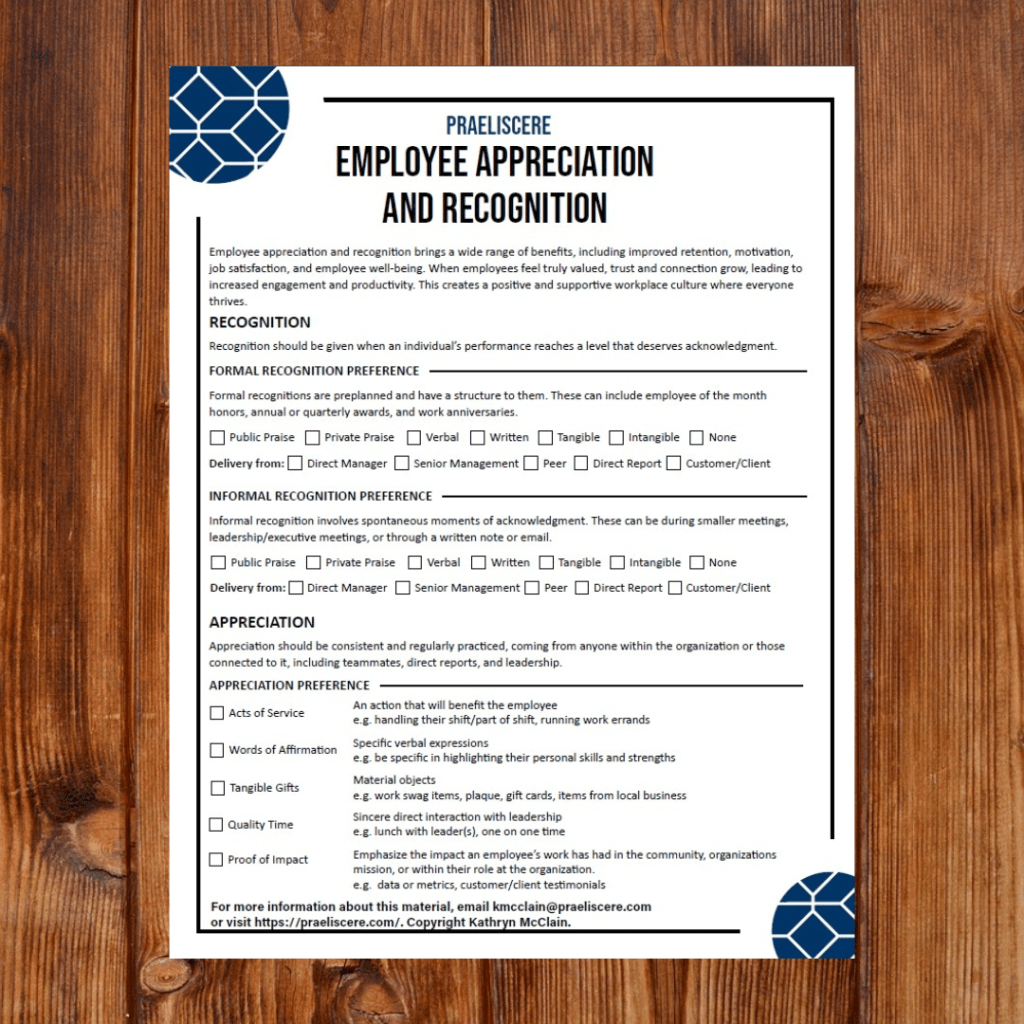
Gain valuable insight into how your team members prefer to be acknowledged with this affordable, easy-to-use downloadable one-sheeter. Designed to support employee engagement, motivation, and workplace culture, this tool helps you identify each individual’s appreciation and recognition preferences.
Collecting this input allows managers, HR professionals, and team leads to deliver meaningful recognition that truly resonates—boosting morale, increasing retention, and fostering a more connected, high-performing team.
Affordable, Instant Download: Milestone Achievement Reward Selection One-Sheeter
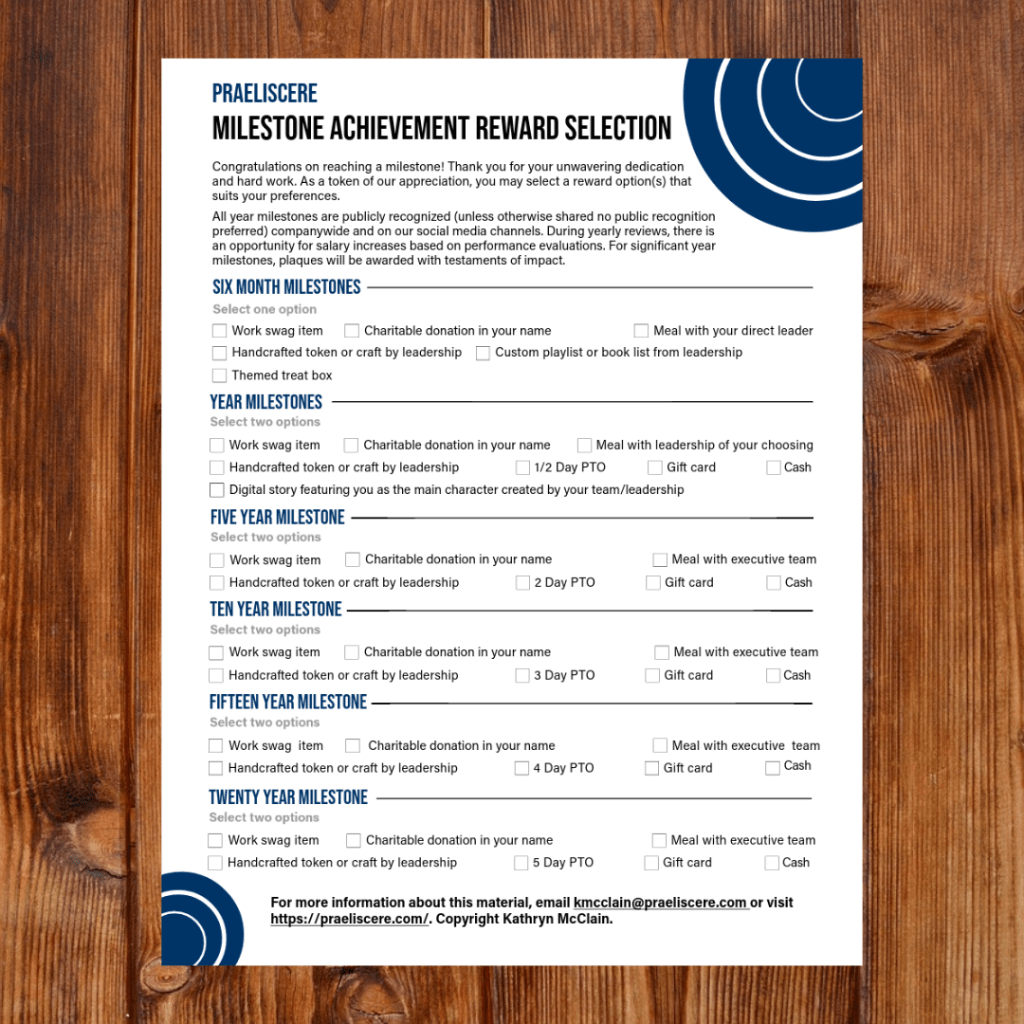
Celebrate employee dedication and loyalty with this affordable, easy-to-use and customizable Milestone Achievement Rewards Selection one-sheeter. Designed to support employee recognition, retention strategies, and a positive workplace culture, this resource helps you acknowledge key anniversaries and achievements with thoughtful, personalized rewards.
Use this tool to show genuine appreciation for your team’s ongoing contributions, boost employee morale, and reinforce a culture where hard work and commitment are consistently recognized and valued.
Learn. Apply. Lead.
Practical Insights Delivered. Get access to new tools, reflections, and workplace-ready resources as they’re released monthly.
Stay in the loop with our latest insights, resources, and updates by connecting with us on LinkedIn and Facebook. It’s a great way to engage with our work and join the conversation.
 Praeliscere